Roof leak or worn-out roof? Get connected with a local North Shore roofer.
Leaks, missing shingles, ice dams, flat roofs, and slate. Tell us what is going on, and we will connect you with an independent local roofing professional who serves your town. It is free to request, and you are under no obligation.
What we can help with
Roof Repair
Leaking roof? Get connected with independent local roofers for roof repair in Wakefield, Reading, Melrose, Lynn, Peabody and the North Shore.
Roof Replacement
Planning a new roof? Get connected with independent local roofers for roof replacement in Reading, Wakefield, Stoneham, Woburn, Wilmington and the North Shore.
Storm Damage Roof Repair
Wind, nor'easter, or fallen-limb damage? Get connected with independent local roofers for storm damage roof repair in Lynn, Saugus, Peabody, Malden and nearby.
Flat Roof Repair & Replacement
Leaky flat or low-slope roof? Get connected with independent local roofers for EPDM, TPO, and modified bitumen roofs in Malden, Lynn, Melrose and the North Shore.
Slate Roof Repair
Cracked or slipped slates? Get connected with independent local roofers who repair slate roofs in Melrose, Malden, Lynn, Wakefield and older North Shore neighborhoods.
Why roof leaks and ice dams matter
Small roof problems are easy to miss from the ground, and water that gets past the roof usually does its damage out of sight.
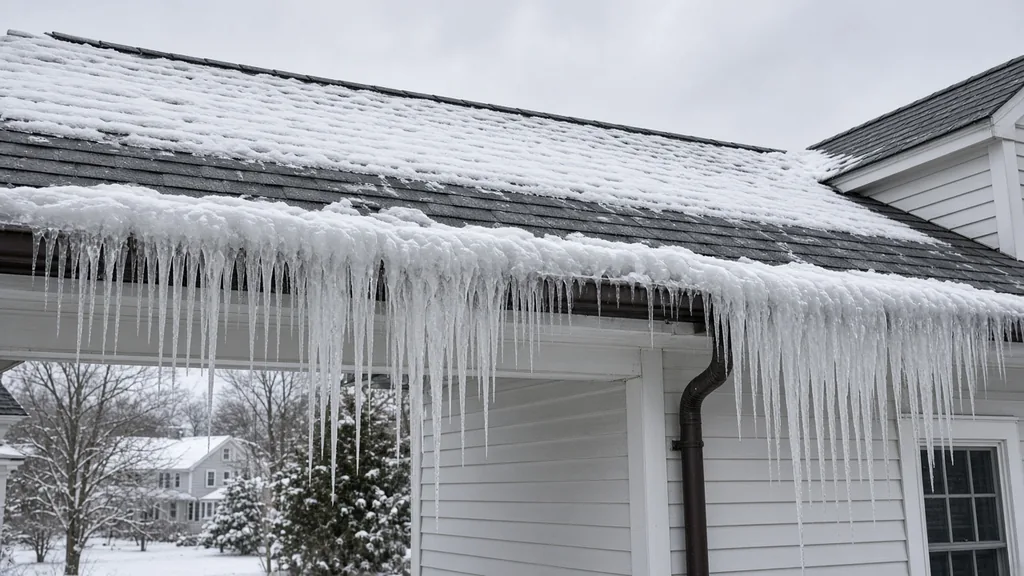
Ice dams push water under shingles
Heat escaping from the living space warms the roof, melting snow that refreezes at the colder eaves. The ice ridge traps meltwater, which can back up under shingles and into the house.(UMass Building & Construction Technology: Preventing Ice Dams, U.S. DOE Building America Solution Center: Attic Air Sealing, Insulating and Ventilating for Ice Dam Prevention)
Leaks damage ceilings, walls, and insulation
Water from ice dams and leaks can stain ceilings, soak and compress insulation so it works less well, and rot framing inside wall cavities.(UMass Building & Construction Technology: Preventing Ice Dams)
Wet attics grow mold
Roof leaks are one of the moisture problems that lead to mold indoors. The EPA advises fixing leaks and drying wet materials within 24 to 48 hours to help prevent mold growth.(EPA: A Brief Guide to Mold, Moisture and Your Home, UMass Building & Construction Technology: Preventing Ice Dams)
Regular inspections catch problems early
The National Roofing Contractors Association recommends inspecting your roof at least twice a year, in spring and fall, and after severe storms. You can check from the ground, and leave walking on the roof to professionals.(NRCA: Consumer Information)
What makes roofing different north of Boston
Snow and wind are written into the building code here. Massachusetts' building code (780 CMR, 10th edition, Table 1604.11) lists a ground snow load of 40 to 50 pounds per square foot and basic design wind speeds of about 118 to 119 mph for the communities we cover. A structural engineer or the building official determines the actual design loads for any project.
The housing is old, too. In Melrose, Lynn, and Malden, roughly 45% to 52% of homes were built before 1940, according to U.S. Census Bureau American Community Survey estimates. Older homes often have several layers of roofing, original slate, or low-slope sections over porches and additions.
Massachusetts also regulates who can do the work. The state's Home Improvement Contractor guidance says new or replacement roofing on an owner-occupied 1 to 4 unit home requires a building permit, a Construction Supervisor License, and Home Improvement Contractor registration. Always ask for those numbers.
Getting help is simple
- Call or fill out the form. Tell us your town and what is going on.
- A local pro contacts you. They talk through the job with you and set up a visit if needed.
- Get a quote and decide. Requesting a quote is free, and you are never obligated to hire.
Towns we cover
Wakefield, MA
Median home built ~1956 · 57% pre-1960
Reading, MA
Median home built ~1960 · 51% pre-1960
Melrose, MA
Median home built ~1938 · 70% pre-1960
Stoneham, MA
Median home built ~1964 · 46% pre-1960
Lynnfield, MA
Median home built ~1964 · 43% pre-1960
Saugus, MA
Median home built ~1962 · 47% pre-1960
Woburn, MA
Median home built ~1968 · 41% pre-1960
Malden, MA
Median home built ~1950 · 56% pre-1960
Lynn, MA
Median home built ~1946 · 63% pre-1960
Peabody, MA
Median home built ~1966 · 40% pre-1960
North Reading, MA
Median home built ~1975 · 28% pre-1960
Wilmington, MA
Median home built ~1979 · 29% pre-1960
Housing figures: U.S. Census Bureau, ACS 2020–2024 5-year estimates.
Frequently asked questions
Is North Shore Roofing Pros a roofing company?
No. We are a free service that connects homeowners with independent local professionals, who are responsible for their own work, pricing, licensing, registration, and insurance.
Does it cost anything to use this site?
No. Sending a request is free for homeowners, and you are never obligated to hire anyone. We may be paid by the professionals we connect you with.
What towns do you cover?
Wakefield, Reading, Melrose, Stoneham, Lynnfield, Saugus, Woburn, Malden, Lynn, Peabody, North Reading, and Wilmington, Massachusetts.
How do I check a roofer before hiring?
In Massachusetts, contractors working on an existing owner-occupied 1 to 4 unit home must be registered as Home Improvement Contractors, and roof replacement also requires a Construction Supervisor License and a building permit. Ask for those numbers, proof of insurance, a written contract, and references.
What causes ice dams?
Ice dams form when heat escaping from the house warms the roof deck and melts snow, which then refreezes at the colder eaves. UMass and the U.S. Department of Energy point to attic air sealing, enough insulation, and roof ventilation as the long-term fixes.
How often should I have my roof inspected?
The National Roofing Contractors Association recommends checking your roof at least twice a year, in the spring and fall, and after any severe weather. Look from the ground with binoculars if you can, and leave climbing on the roof to a professional.
Can a roof leak cause mold?
Yes. The EPA lists roof leaks among the moisture problems that lead to mold. Fixing the leak and drying wet materials within 24 to 48 hours helps prevent mold from growing.